
Marketing Mutuality: Why Building Societies are Losing Gen Z to Neobanks (And How Martech Can Begin To Help Win Them Back)

In our last post, we explored how Generative AI could be a quiet force multiplier for building societies, reinventing their back-office operations in underwriting and compliance.

But while a hyper-efficient back office is essential for survival, it doesn’t solve the sector’s most glaring problem: growth. Especially growth in the smaller and medium sized mutuals/building societies.

In this blog post I begin to explore the profound paradox at the heart of UK retail banking. We have a new generation of consumers, Gen Z, who are purpose-driven, value transparency, and are deeply sceptical of shareholder-first capitalism. In theory, they are the perfect demographic for the building society model. A member-owned, community-focused, profit-sharing institution is the very definition of a “purpose-driven” brand.

And yet, where is Gen Z’s money? It’s in Monzo pots, in Starling “Spaces,” and being managed via Revolut.

This isn’t just a marketing failure; it’s a translation failure. The building society sector is failing to translate its greatest asset—mutuality—into a language this generation understands. They are selling an analogue concept of “trust” in a digital-first world.

The battle for the next generation of members won’t be won with adverts about heritage; it will be won on the app store. It is a problem that “tech” is uniquely positioned to solve and I try to draw out this perspective below

The Neobank Playbook: Marketing Experience

To understand why building societies are losing, we first must analyse why neobanks are winning.

Neobanks did not win by offering better savings rates or more complex mortgage products. They won by focusing on a single, core principle: eliminating friction.

Their entire marketing strategy is their user experience (UX).

  • Onboarding: You can open a Monzo account in the time it takes to make a cup of tea. For many building societies, it can still involve branch visits, posted documents, and a multi-day waiting period.
  • Control: Neobanks provide real-time, granular data. Instant payment notifications, automatic spending categorisation, and the ability to create savings “pots” give the user a feeling of absolute control over their finances.
  • Brand: The brand voice is that of a helpful tech partner, not an august financial institution. It’s built for social media, not a bank manager’s office.

This tech-first approach has fundamentally changed the definition of “trust.” For older generations, trust was built over decades (“heritage,” “stability,” a physical branch). For Gen Z, trust is built in seconds (“Does this app work seamlessly? Is it transparent? Does it put me in control?”).

Neobanks are marketing utility, and as a result, they are winning the generation that values utility above all else.

The Building Society’s Dilemma: Marketing Heritage

Faced with this, the building society sector’s typical marketing response is to lean on its traditional strengths: “trust,” “community,” and “member-owned.”

This is a losing proposition. Not because those values are wrong, but because they are being communicated through the wrong medium.

  • When a 22-year-old is faced with a clunky, slow app, the marketing message of “trust” doesn’t just fall flat; it feels like a lie. The poor digital experience becomes a direct proxy for the entire institution: slow, old, and out of touch.
  • “Community” feels like an abstract concept when the app offers less functionality than a brand that is barely a decade old.
  • “Member value” is meaningless if the member has to phone a call centre to perform a simple task.

The sector is trying to sell a “why” (we are member-owned) without first providing a competitive “what” (a seamless digital platform). The neobanks did the opposite: they perfected the “what,” and their “why” (making money easy) simply followed.

Bridging the Gap: Using Martech to Translate Mutuality

This is where the “merging” of finance and tech becomes a marketing strategy. Building societies don’t need to become neobanks. They need to use the same “Martech” (Marketing Technology) tools to prove their mutual model is superior.

They must stop selling “mutuality” as a concept and start delivering it as an experience.

1. From “Personal Service” to “AI-Driven Personalisation”

The traditional selling point of a building society was the branch manager who knew your name. This doesn’t scale in a digital world, but the ethos behind it can.

The modern equivalent is hyper-personalisation. This is where the AI we discussed in our last post pivots from a compliance tool to a marketing engine.

  • Analogue: A branch manager notices you’re saving and suggests a new account.
  • Digital: The society’s app uses a Martech platform to analyse a member’s goals. It sends a proactive, personalised nudge: “We see you’re saving in your easy-access account. As a member, we can offer you an extra 0.5% in our new First Home Saver. Tap here to move your money.”

This is no longer an abstract “member benefit.” It is a tangible, digital-first experience that proves the society is proactively working for the member’s financial well-being.

2. From “Community” to “Content-as-a-Service”

Building societies rightly pride themselves on their community focus, which often manifests as sponsoring a local team or high-street branch events.

For a digital-native, “community” is found online. The single greatest failure of the sector is its surrender of the financial education space to “fin-fluencers” and neobanks.

  • Analogue: A “First-Time Buyer” event in a branch.
  • Digital: A powerful, integrated content marketing strategy. The society’s app should be a hub for financial literacy: jargon-free articles, in-app calculators for deposit saving, and short-form videos (yes, TikToks or YouTube) that genuinely help Gen Z navigate the cost-of-living crisis or understand their credit score.

This approach transforms “community” from a slogan into a service. It digitally demonstrates the society’s commitment to its members’ financial health, building the exact kind of trust that Gen Z values.

3. From “Member Value” to “Member Experience (MX)”

The ultimate “member value” is the annual dividend or “Fairer Share” payment. While a welcome bonus, it’s a once-a-year event. A neobank provides “micro-value” dozens of times a day with every instant notification and spending summary.

Building societies must redefine “member value” as the entire Member Experience (MX). The app is the brand. The ease of applying for a mortgage is the brand. The speed of a money transfer is the brand.

Every point of friction—every clunky interface, every broken link, every need to phone a call centre—is a marketing failure. It is an active statement that the member’s time is not valued.

The Hybrid Advantage: Reimagining the Branch

This commitment to a flawless digital experience does not mean the branch is obsolete. Quite the opposite. It makes the branch more powerful than ever.

Neobanks have a critical vulnerability: they are 100% digital. For complex, high-emotion financial “moments that matter,” their model shatters. You cannot, and should not, get a mortgage, manage a bereavement, or navigate financial hardship over a chatbot.

This is where building societies have an unassailable advantage, if they integrate it with their tech.

The branch must evolve. It is no longer a place for transactions (like paying in a cheque—that’s what the app is for). It must become a high-value consultation hub.

This is how the “phygital” (physical + digital) journey should work:

  1. Digital Identification: The society’s AI identifies a member on the app who is saving into a “First Home” pot (a Gen Z member). When the balance hits a certain threshold, the app triggers a new kind of marketing message.
  2. Seamless Escalation: Instead of a generic ad, the app says, “Congratulations on hitting your £10,000 saving goal. You’re ready for the next step. Would you like to book a video call, or pop into your local branch to chat with our mortgage adviser, Sarah, about what happens next?”
  3. Empowered Staff: When that member walks into the branch, Sarah already has their full financial picture on her screen. The member doesn’t need to start from scratch. The conversation is high-value from the first minute.

This is the hybrid advantage. It combines the seamless utility of a neobank with the empathy and expert advice that only a human-staffed branch can provide. While big banks are seen as abandoning communities by closing branches, building societies can market their presence as a deliberate choice—a premium service for the moments that matter.

This is an advantage neobanks simply cannot buy.

Stop Selling the Past. Start Proving the Future.

The irony is that building societies already have the one thing the neobanks are spending billions to build: a genuine, purpose-driven brand.

But they are trying to sell this story instead of showing it.

The fight for Gen Z will not be won with better slogans. It will be won by the institutions that can successfully merge their “why” (mutuality) with the “how” (seamless, predictive, and educational tech). I should also point out that this also applies to many other segments such as Millennials and Baby Boomers, who now expect a certain baseline of digital services.

Although, it maybe not the whole answer, it’s part of the answer to how Mutuals evolve. To survive Mutuals must stop marketing what they were and start using Martech to prove what they are: a genuinely better alternative. 

I’ve covered a lot of ground in this post. Feel free to disagree, agree or posit alternative views, happy to hear them all

best

MN
Beyond the Hype: Where Generative AI is Actually Adding Value in Financial Services (It’s Not Just Chatbots)

It’s been a few weeks since we’ve really dug into the “next big thing” here. As I mentioned in my last post, after a bit of a hiatus, it’s exciting to be back observing the emergence and merging of banking, finance, and technology. And frankly, there has never been a more disruptive moment to jump back in.

You can’t have a conversation about tech today without tripping over “Generative AI.” For most of the public, and even for many in our industry, the immediate mental leap is to the customer-service chatbot.

We’ve all seen the demos: a slick, conversational interface that can answer “What’s my balance?” or “Explain a mortgage.” This is useful, certainly. It’s an evolution of the clunky, rule-based bots we’ve tolerated for years.

But this is the tip of the iceberg. And as is so often the case in finance, the most profound changes aren’t the ones on the customer-facing billboard. The real revolution is happening in the middle and back office—in the complex, data-heavy, and regulation-drenched engine room of the bank.

Years ago, we were all talking about “Big Data” and its potential (You can scroll down to my post on this from a few years ago). Generative AI is the engine that finally unlocks it. It’s moving us from analytics (what happened) to automation and augmentation (what to do next).

If you want to see where GenAI is really changing the game, in financial services at present, look past the chatbot and focus on these three areas.

1. Supercharging Compliance and RegTech

For any modern financial institution, compliance isn’t just a department; it’s a foundational cost centre and a critical risk. The sheer volume of new and updated regulations is staggering.

This is where Large Language Models (LLMs) shine.

  • The Problem: A bank’s compliance team has to read, interpret, and implement hundreds of pages of dense regulatory text from multiple jurisdictions. They must then monitor internal communications (emails, chats) and transactions for potential breaches of rules like KYC (Know Your Customer) and AML (Anti-Money Laundering).
  • The GenAI Solution: Instead of rules-based systems that flag keywords (“guarantee,” “promise”), GenAI models can understand context and intent. They can read a 300-page regulatory update and instantly generate a summarised “to-do” list of policy changes. They can scan communications and flag a conversation that feels collusive or evasive, even if it doesn’t use specific trigger words. This isn’t about replacing the compliance officer; it’s about giving them a team of a thousand junior analysts, allowing them to focus on high-level judgement.

2. The New Frontier of Underwriting and Fraud

We’ve used AI in risk modelling for years, but it’s largely been a game of structured data—credit scores, transaction history, income. This approach is powerful but blind to the world of unstructured data.

  • The Problem: A traditional underwriting model for a small business loan knows the company’s cash flow, but it doesn’t know about the new competitor that just opened across the street, the negative sentiment in local news, or the supply chain risk mentioned in an industry report.
  • The GenAI Solution: GenAI can read, understand, and summarise all of it. An underwriter can now get a rich, contextual summary in seconds: “Applicant is a 5-year-old cafe with stable cash flow. However, recent local news articles show a 30% decline in foot traffic for its neighbourhood, and two new competitors have opened within a mile in the last six months.” The human makes the final call, but now they’re armed with a complete picture. The same applies to fraud, where models can now spot suspicious narratives and connections between seemingly unrelated accounts, not just isolated, anomalous transactions.

3. Personalising Wealth Management at Scale

True, hyper-personalised financial advice has historically been the exclusive domain of high-net-worth individuals. It required a human adviser to spend hours analysing a client’s portfolio against their personal goals and the entire universe of market data.

  • The Problem: It’s impossible to offer this level of service to the mass market. There just aren’t enough hours in the day.
  • The GenAI Solution: We’re now seeing the rise of the “AI Co-pilot” for financial advisers. This tool can analyse a client’s complete financial picture, ingest their stated goals (e.g., “retire in 10 years,” “save for a house”), and monitor real-time market news. It can then draft personalised insights for the adviser: “Based on today’s interest rate hike and Client Smith’s risk profile, here are three high-yield bond ETFs to discuss with them. Here is a summary of the pros and cons for each, and a draft email to start the conversation.”

This isn’t a robo-adviser replacing the human; it’s a “robo-analyst” that empowers the human to be a true strategist for every single client, not just the wealthiest.

The Mutual Angle: A Different Set of Stakes

Now, for the UK’s building society sector, the “emergence and merging” of this tech has a unique flavour. A global bank can invest billions in GenAI to chase efficiency. A building society, owned by its members, has a different calculation: how to innovate without losing its identity.

Their brand is built on trust, community, and a personal touch—assets that are easily damaged by poorly implemented tech. The temptation to just “install a chatbot” to keep up with the digital-first banks is huge, but it’s a trap. Research shows members, particularly the long-standing ones, are wary of AI and value human interaction.

For the mutual sector, the real impact of GenAI isn’t about replacing that human touch; it’s about supercharging it.

  1. Smarter Mortgage Underwriting: This is the core business. Instead of just structured data, a GenAI-assisted underwriter can analyse and strucure local council planning documents, property surveys, and even company accounts in seconds. This doesn’t replace the human underwriter’s decision; it gives them a “superpower,” allowing them to make a more informed, nuanced judgement on complex applications like for a self-employed person or a Ltd Company that a big bank’s algorithm might simply reject. It’s an efficiency tool that doubles as a competitive advantage.
  2. Compliance on a Mutual’s Budget: Building societies face the same crushing regulatory burden as the high-street giants (Consumer Duty, AML, fraud) but with a fraction of the compliance staff. This is where GenAI is a massive force multiplier. It can automate the drafting of regulatory reports, scan for fraud, and process member complaints (a key part of Consumer Duty) with a speed and accuracy that a small team simply cannot match. It helps them “punch above their weight” in risk management.
  3. Delivering on the “Member-Centric” Promise: The “AI Co-pilot” concept is even more critical here. It’s not about “wealth management” for the few, but about “financial well-being” for all members. Imagine a branch colleague, empowered by an AI tool, who can instantly see a member’s full history and get a prompt: “This member’s fixed-rate savings account is maturing. Based on their goals and our current products, here are two options to discuss.” It’s technology used to foster a more meaningful human conversation.

For building societies, GenAI is a tool that allows them to solve their digital dilemma: it provides the back-office efficiency to compete, while simultaneously empowering their staff to double down on the very thing that makes them different.

The theme of this blog has always been the “merging” of finance and tech. For the first time, this isn’t just about digital channels or faster databases. It’s about embedding intelligence into the very core of what a financial institution does: manage risk, ensure compliance, and provide advice.

The chatbot is just the interface. The real story is the engine. And it’s an engine that’s in the process of being completely rebuilt—for everyone, from the global banks to the local building society. The only question now is how quickly firms can adapt their culture and processes to leverage it.

Ready to discuss? I’d love to hear your thoughts on this, or what you’d like me to deep-dive into next. Let me know in the comments or drop me a note!

MN

Future-Proofing Mutuality: Why UK Building Societies Can’t Afford to Ignore Technology

Hello everyone, and thanks for joining me again. As many of you know, I’ve recently changed jobs and am now leading marketing for a UK building society. It’s an exciting move, and I’ll be using this blog as a space to also share what I’m learning, thinking about, focusing on the unique and fascinating UK building society sector, along with the regular topics I post about.

Now, for those of you who aren’t familiar with them, you might be asking: what exactly is a building society?

Simply put, a UK building society is a financial institution that’s owned by its members. Unlike a commercial bank, which is owned by external shareholders, our members are the people who have a savings account or a mortgage with us. This fundamental difference in ownership shapes our entire purpose. Instead of just chasing profits to pay dividends, our main goal is to look after the best interests of our members.

Purpose and History

The core of a building society is to help people buy homes and provide a safe place to save. They’ve been doing this for a long time. The history of building societies goes all the way back to the late 18th century, when groups of people would literally pool their savings together to help each other build houses. The idea was simple: when enough money was saved, one person would get a loan to build a home. Once everyone had a home, the group would dissolve.

This model evolved into the “permanent societies” we know today, which stay open indefinitely, constantly welcoming new members. While we’ve expanded our services, our core structure remains the same:

  • Member Ownership: If you have a savings or mortgage account with us, you’re a member.
  • One Member, One Vote: No matter how much money you have, every member gets one vote at our Annual General Meeting. It’s a truly democratic model, giving members a real say in how the society is run.
  • No External Shareholders: Because we don’t have outside shareholders to please, we can reinvest our profits to offer better interest rates on savings and lower rates on mortgages.

This mutual model isn’t just a British thing. Similar institutions, like credit unions in the US and cooperative banks across Europe, and across Asia, share the same core principle of being member-owned. They might have different names and slightly different rules, but their purpose is the same: to put members before profits.

The Digital Challenge: Why It’s Not Just About Members

In a world where digital-first banks and agile fintechs are everywhere, building societies face a serious challenge. While we still hold a huge portion of the nation’s savings and mortgages (asset base of £648.3 billion) and have a great high-street presence (30% of all high street branches), our digital experience often lags behind.

Recent research highlights a clear gap between what members expect and what is often delivered. A study by Moneyhub found that nearly half of building society members reported difficulties engaging with services, with the digital experience being a frequent pain point. Furthermore, for younger generations (aged 18-34), an easy-to-use mobile app is the second-most important factor when choosing a financial provider. 

Almost half of building society members have reported difficulties with digital services, and for younger generations, a top-notch mobile app and a good digital experience is a deal-breaker. But it’s more than just a direct-to-member problem. We also have to consider our crucial partners:

  • Intermediaries and Brokers: If a broker finds our online portal clunky or slow, they’re more likely to take their business to a competitor. We need to make their lives easier, not harder.
  • Our Own Branches: Our branch teams are our brand ambassadors. When they’re bogged down with outdated systems, it takes time away from what they do best: providing personalised, human-centric service.

The pressure to modernise is real. And it’s particularly tough for smaller societies that don’t have the multi-billion-pound budgets of the big players like Nationwide. How can a smaller society with limited resources develop an app that competes with a Starling or a Monzo? How can we attract top tech talent away from big-city Fintechs? These are the questions keeping many of us up at night.

Technology: Our Secret Weapon

Here’s the thing: technology is not the enemy. It’s our best friend when it comes to preserving our mutual values. It’s about using technology to free up our people to do what they do best—provide brilliant, human-centred service.

1. Data & Personalisation: Thanks to things like Open Banking, we have access to a huge amount of data (with member consent, of course!). This allows us to move away from generic communications and offer truly personalised advice and products. For example, we can analyse a member’s spending to suggest a savings plan that actually works for their lifestyle. It’s about being a genuine partner, not just another bank.

2. AI & Automation: I know our branch staff and our intermediary teams are our greatest assets. They provide the personal service that defines us. But what if they could spend less time on paperwork and more time building relationships? That’s what AI can do. By automating tasks like mortgage underwriting or reporting, we can free up our people to have more meaningful conversations. This is how we can deliver a level of service that no automated bank can match.

As a marketer in this sector, seeing these ideas in practice makes all the difference. AI and automation are no longer just for the back office; they’re becoming essential tools for us, too. They can help us be more effective in several ways:

  • Smarter Content Creation: AI can help us brainstorm blog post ideas, write social media captions, or even draft the first version of an email campaign. This frees up my team to focus on the strategic side of things.
  • Hyper-Personalised Campaigns: This is where AI truly shines for a building society. Instead of just segmenting our members by age or postcode, we can use AI to analyse their data to create a genuinely hyper-personalisedcampaign. We could automatically send a potential first-time buyer a tailored email with tips on saving for a deposit, or offer a loyal saver a new interest rate before they even think about looking elsewhere.
  • Faster Performance Analysis: Running a marketing campaign used to involve a huge amount of manual data crunching. Now, AI-powered tools can analyse campaign performance in real-time, telling us which ads are working and which aren’t. We can then adjust our spending and messaging on the fly, ensuring every pound we spend on marketing is working as hard as possible.

A New Era of Scale

The UK building society sector is already demonstrating a powerful understanding of how to use scale to invest in technology. The recent acquisitions of Virgin Money by Nationwide Building Society and The Co-operative Bank by Coventry Building Society are excellent examples.

These mergers are not simply about increasing market share; they are about creating the scale and capital needed to invest in digital platforms, modernise legacy systems, and compete with large retail banks on their own terms. By growing their asset base, these societies are able to fund the significant technological transformation required to attract and retain the next generation of members. They are proving that mutuality and modernisation can thrive together.

The ‘So What?’

So, what does this all mean for us?

Ultimately, the choice isn’t between tradition and technology. It’s between smart, strategic evolution and gradually becoming irrelevant. The future of our brand and our business depends on embracing this challenge head-on.

We can’t outspend the big banks, but we can definitely outsmart them. The true ‘so what’ is that our core values of trust, community, and personal service are more important than ever. We just need to use the right tools to make sure our brand is as relevant to a young first-time buyer as it is to our most loyal savers. Our digital future isn’t about becoming a big bank; it’s about becoming a better building society for everyone.

Ready to discuss? I’d love to hear your thoughts on this, or what you’d like me to deep-dive into next. Let me know in the comments or drop me a note!

MN

Lost and Found: A Blog’s New Beginning

It’s been a while, hasn’t it? If you’re seeing this, you’ve landed on a corner of the internet that’s been quiet for far too long. After years of radio silence, I’m finally dusting off the keyboard and getting back to it.

When I last wrote here, the world—and this blog—looked a lot different. Life happened, priorities shifted, and this space went into a deep slumber. In the time since, I’ve gone through a few digital overhauls, and unfortunately, many of the older posts didn’t make the journey. It’s a bit bittersweet to see them go, like old photographs lost in a move. They were a part of the journey, a record of where this all began.

But as with any fresh start, looking back is only half the story. The best part is looking forward. I’m excited to start writing and sharing with you all again. I’m not sure exactly what this space will become yet, but will continue to talk about the emergence/merging of Banking, Finance and Tech. So, thank you for being here, whether you’re a long-time reader or just stumbled upon this today.

Let’s see what we can build next.

Its only Data…

Money, at some basic level, is just data.

In a world where more than 90% of data in the world today has been created in the last two years (1), the Fintech industry sector is increasingly showing the importance of data as a driver of disintermediation within banking by developing new tailored products & services, often via novel channels that are embedded in smart technology (e.g. smartphones & watches) and social networks.

The author has recent experience in commercialisation of Big Data, having recently exited a start-up (SIG Group), which focused on value capture in Infrastructure. Similarly, data is providing an opportunity for banks, beyond simple financial reporting and MIS by increasing the speed and means of delivering enhanced services and products such as robo-advice and live chat analytics, allowing nimbler responses to issues and product development.

The financial industry has been challenged over the past several years, with the pressures on Capex/Opex reduction or outsourcing in order to achieve efficiencies and offset the cost of greater regulation and low margin environment. Customers are also becoming increasingly aware of how their data is being commoditised and its intrinsic financial value and want greater control over its use. Banks are also trying to keep up with customers increasing interconnectivity and come to terms with technologies that are transforming other sectors from taxis to hotels to telecoms. Customers increasingly want frictionless, convenient and personalised experiences and sometimes cannot comprehend why they’re unable to perform certain tasks on their Banking App; or simply why their bank asks them for information again and again  ‘when they hold the data’.

Increasingly, companies who effectively utilise intangible assets such as Data, see higher enterprise valuations, Amazon is an excellent example of this (2). This provides an advantage (and perhaps some respite) for incumbent institutions which hold vast amounts of consumer data, by providing another lever to help drive value (and ultimately share price) and commercial advantage.

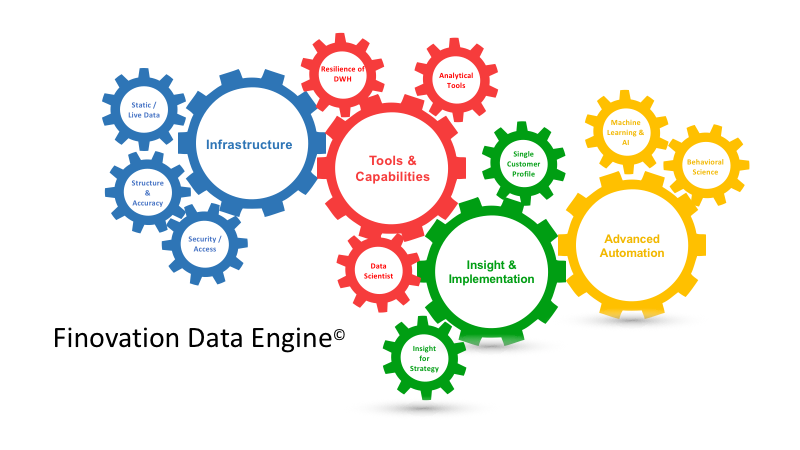
This blog post covers data at a high level and will introduce several themes and the Finovation Data Engine (Exhibit 1), which we will explore in detail in subsequent posts.

Finovation Data Engine
Exhibit 1: Finovation Data Engine

The financial services industry is, fundamentally, powered by data: this ranges from data on what available funds may be in a customer’s account, to data that helps validate someone’s identity in money laundering checks.

We are seeing several exciting themes emerge in data:

  • New Battlegrounds: large consumer ecosystems (such as Apple, Facebook, Amazon and Google) hold vast amounts of data which can be used to gain insights on behaviour and help drive decisions and delivery of products. Increasingly, live and static data is being merged in the offline world (3)… what’s to stop ApplePay becoming a fully-fledged Finco by not just moving money but also providing credit.

Continue reading “Its only Data…”

Hello & Introduction

We have been riding a new wave of technologies – such as API’s, digital wallets and robo-advice for the last few years. These technologies promise to revolutionise the way we manage, control and distribute money. Gone are the days where you had to go to your local branch or call the customer service centre. Today, your smart phone loaded with your mobile banking app, allows you to complete an ever increasing amount of tasks, whenever, wherever you want – no human interaction required.

Every aspect of the financial services industry is being disrupted by new technologies, forcing the traditional banking sector to re-evaluate and invest in digital innovation, and changing the face of money as we know it.

The trend is driven by new entrants, which also involves a lot of hype and rhetoric, we see the likes of Starling, Tandem (home of one of our bloggers !) and many more challenging the incumbent providers. We also see that UK Regulators have greased the wheels of change by adapting and adopting changes to regulations to drive increasing competition (FCA Sandbox, Project Innovate etc), which hopefully drives competition with ultimately consumers benefiting.

I liked this quote/question from a recent Deloitte report : ‘The question is not whether the disruptions that we are witnessing today will transform banking and capital markets, but, rather, how will they do so? Where will the new entrants have the most success? What technological disruptions will take root and transform the way business is done? What areas will remain under the dominance of incumbents? How will incumbent organisations have to adapt to thrive in the new ecosystem?’

The aim of this blog is to drive a discussion based on these and associated themes to hopefully help us start answering this rather basic but complex questions – with your help!

All good things
MN